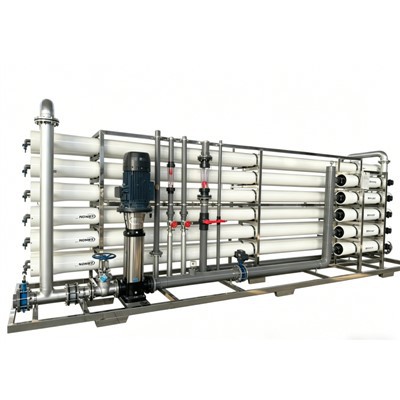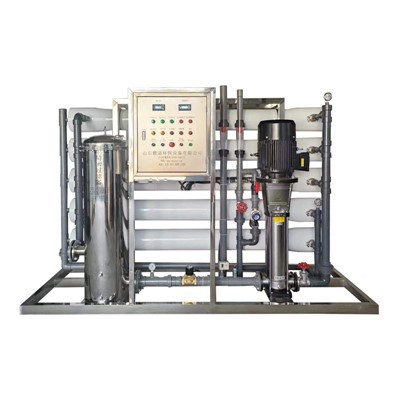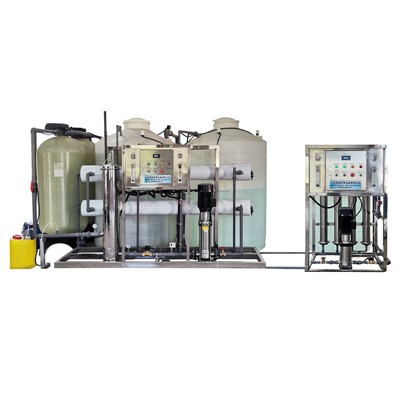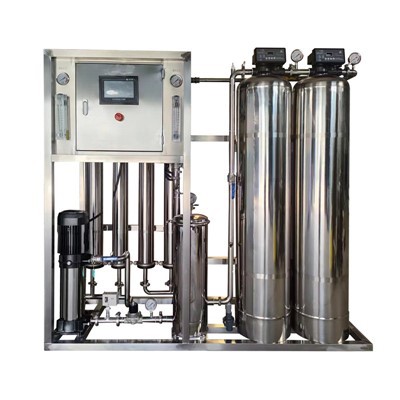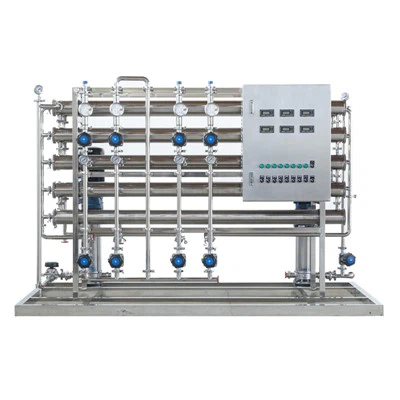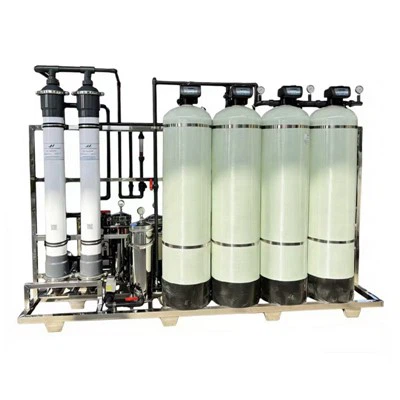

Reverse osmosis technology relies on pressure greater than osmotic pressure to achieve filtration through the capillary action of a membrane.
The reverse osmosis process comprises three parts: pretreatment, membrane module connection, and post-treatment.
Pretreatment, also known as pre-treatment, aims to improve the quality of the treated water, prevent contaminants from fouling the membrane, extend membrane lifespan, and reduce operating costs.
Membrane module connection methods: Commonly used in single-stage and multi-stage connections (multi-stage). Single-stage refers to the feed undergoing one pressurization for membrane separation; two-stage separation requires two pressurizations.
Post-treatment: Permeate water, also known as freshwater, is the water that passes through the reverse osmosis membrane after pressurization. Since the membrane cannot retain 100% of inorganic and organic matter, the permeate water inevitably contains some ions and gases, such as Na+, HCO3-, and CO2. For high-purity water applications, further post-treatment processes such as ion exchange and deoxygenation towers are necessary.
Reverse osmosis is widely used in the desalination of seawater and brackish water, the purification of drinking water in the food industry and the pharmaceutical industry, and is particularly suitable for industries that require both desalination and removal of bacterial particles. The equipment has functions such as automatic flushing, online water quality detection and flow monitoring, and automatic shutdown when the pure water tank is full, and can achieve 24-hour unattended operation. The equipment is equipped with a wastewater recirculation setting, which can reuse water and improve water utilization. The equipment uses imported core electrical components; it has a low-pressure protection system that automatically shuts down when the source water pressure is insufficient; it has a cleaning and maintenance system that can clean regularly to extend the service life of the reverse osmosis membrane. Reverse osmosis membrane separation technology can separate solutes and water under the condition of no phase change at room temperature. It is suitable for the separation and concentration of heat-sensitive substances and has low energy consumption; it has a wide range of impurity removal and has a high desalination rate and water reuse rate. The equipment system is simple, and its operation, maintenance, and automation are easy. Pre-treatment effectively removes various salts and impurities from the water, delays membrane fouling, and ensures stable product water quality.