Osmosis is a common phenomenon in nature. For example, if a cucumber is placed in salt water, it will lose water and shrink. The process of water molecules from the cucumber entering the salt water solution is osmosis. If a pool of water is divided into two parts by a membrane that only water molecules can pass through, and pure water and salt water are poured into each side of the membrane to the same height, after a period of time, the level of pure water will decrease, while the level of salt water will increase. This phenomenon of water molecules migrating through the membrane into the salt water is called osmosis. The rise in the salt water level is not endless; it will reach an equilibrium point at a certain height. The pressure represented by the difference in liquid levels across the membrane at this point is called osmotic pressure. The magnitude of osmotic pressure is directly related to the concentration of the salt water.
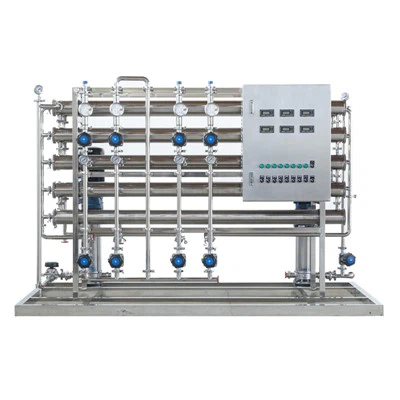
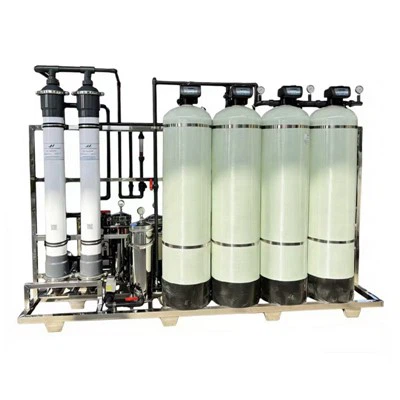
After the above device reaches equilibrium, if a certain pressure is applied to the surface of the salt water side, water molecules will migrate from the salt water side to the pure water side. This phenomenon of liquid molecules migrating from a dilute solution to a concentrated solution under pressure is called reverse osmosis. If brine is added to one end of the above-mentioned device and pressure exceeding the osmotic pressure of the brine is applied to that end, we can obtain pure water at the other end. This is the principle of reverse osmosis water purification. There are two key factors in reverse osmosis systems producing pure water: a selective membrane, called a semi-permeable membrane, and a certain pressure.
Simply put, the reverse osmosis semi-permeable membrane has numerous pores, the size of which is comparable to the size of water molecules. Since bacteria, viruses, most organic pollutants, and hydrated ions are much larger than water molecules, they cannot pass through the reverse osmosis semi-permeable membrane and are separated from the water that does pass through. Among the many impurities in water, dissolved salts are the most difficult to remove. Therefore, the water purification effect of reverse osmosis is often determined by the desalination rate. The desalination rate of reverse osmosis mainly depends on the selectivity of the reverse osmosis semi-permeable membrane. High-selectivity reverse osmosis membrane elements can achieve a desalination rate as high as 99.7%.