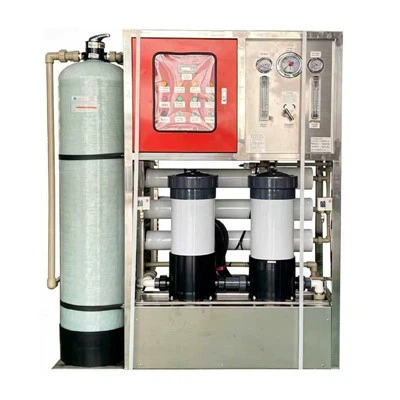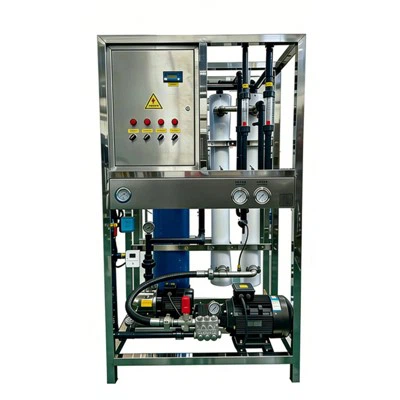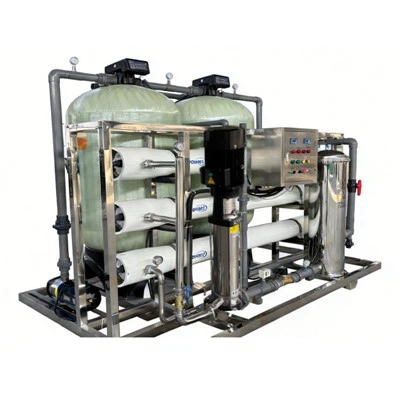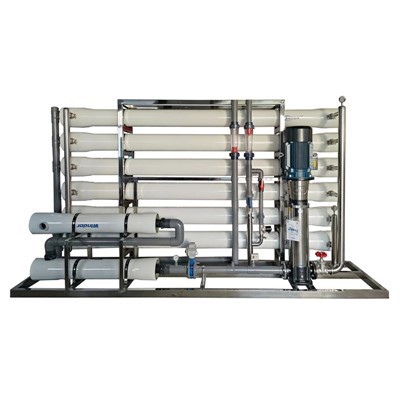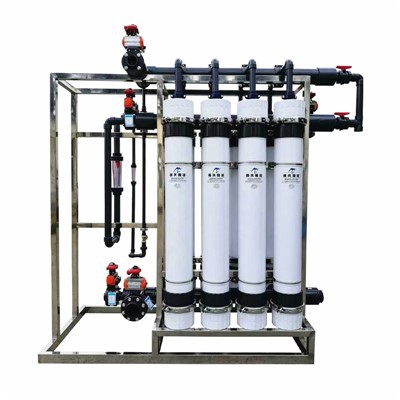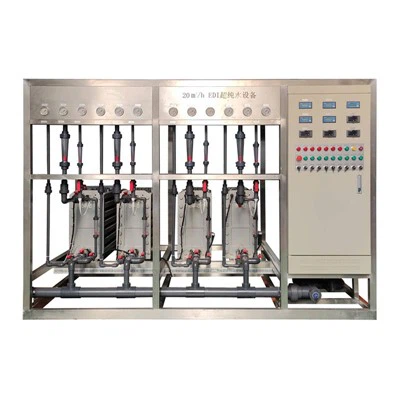


An Industrial Multimedia Water Filter is a pressure filtration unit used to remove suspended solids, sediment, sand and other particulate impurities from industrial raw water. It uses multiple layers of granular filtration media with different particle sizes and densities to capture particles throughout the filter bed.
The equipment is commonly installed before reverse osmosis (RO), ion exchange and other water purification processes. It serves as a physical pretreatment stage to reduce particulate loading on downstream equipment.
A typical system consists of a pressure vessel, upper water distributor, anthracite layer, quartz sand layer, graded gravel support layer and lower underdrain system. During normal operation, raw water flows downward through the media bed. Backwashing reverses the flow direction to remove accumulated contaminants.
Key Features
Multi-Layer Filtration: Anthracite and quartz sand provide different particle-retention characteristics, allowing suspended solids to be captured at different depths within the filter bed.
Water Distribution System: The upper distributor distributes incoming water across the media bed, while the lower underdrain collects filtered water and distributes backwash water.
Backwashable Filter Structure: Upward-flow cleaning loosens the filter media and removes accumulated particles without replacing the media after every filtration cycle.
Pressure Vessel Construction: The enclosed vessel supports pressurized filtration and connection to industrial water treatment pipelines.
System Integration: The filter can be installed as an individual pretreatment unit or integrated with cartridge filters, RO systems and water softening equipment.
Technical Specifications
|
Parameter |
Typical Engineering Specification |
|
Equipment Type |
Vertical Pressure Multimedia Filter |
|
Vessel Diameter |
300–3,000 mm |
|
Vessel Height |
1,500–4,500 mm |
|
Treatment Capacity |
1–100 m³/h |
|
Design Pressure |
0.6–1.0 MPa |
|
Operating Pressure |
0.2–0.6 MPa |
|
Filtration Velocity |
8–15 m/h |
|
Filtration Direction |
Downward Flow |
|
Anthracite Particle Size |
0.8–1.8 mm |
|
Quartz Sand Particle Size |
0.5–1.2 mm |
|
Supporting Gravel Size |
2–32 mm |
|
Total Media Bed Depth |
800–1,200 mm |
|
Backwash Rate |
12–18 m/h |
|
Backwash Duration |
5–10 minutes |
|
Vessel Material |
Carbon Steel or Stainless Steel |
|
Internal Components |
Water Distributor, Underdrain, Media Support |
|
Control Mode |
Manual or Automatic |
|
Pipe Connection |
Flanged Connection |
Applications
RO Pretreatment: Removes suspended particles and reduces turbidity before reverse osmosis membranes. Additional cartridge filtration may be required to meet membrane feedwater requirements.
Industrial Process Water: Provides preliminary particle removal for manufacturing facilities using treated water in production processes.
Boiler Feedwater Preparation: Serves as an initial filtration stage before softening, demineralization and other water conditioning processes.
Food and Beverage Processing: Filters source water before further purification. Additional treatment is necessary to meet application-specific hygiene and water quality standards.
Groundwater and Surface Water: Removes sediment, sand and suspended particles from suitable well water, river water and other raw water sources.
Industrial Circulating Water: Supports suspended solids removal in suitable industrial water circulation treatment systems.
Working Principle
Filtration Stage
Raw water enters the upper distribution system and flows downward through the anthracite and quartz sand layers. Larger particles are generally retained in the upper media, while smaller suspended particles are captured deeper within the filter bed. The graded gravel layer supports the filtration media and protects the lower collection system. Filtered water passes through the underdrain and exits through the outlet.
Backwashing Stage
As particles accumulate, pressure loss across the media bed increases. When the differential pressure reaches the configured cleaning threshold, the system enters backwashing mode.
Backwash water flows upward through the filter bed to loosen the media and remove accumulated contaminants. The dirty water is discharged through the drain outlet. After backwashing and media settling, the filter returns to normal operation.
Customization Options
Vessel Arrangement: Single-vessel or multiple-vessel configurations can be selected according to project capacity and operating continuity requirements.
Pipeline Integration: Inlet, outlet, drain and backwash connections can be coordinated with upstream pumps and downstream treatment equipment.
Control System: Manual operation or automatic valve sequencing can be incorporated according to the required operating arrangement.
Electrical Adaptation: Control cabinet and electrical arrangements can be coordinated with the installation site's power supply standards.
System Engineering: Equipment layout and connection arrangements can be integrated into new water treatment installations or existing treatment lines.
FAQ
Q: What contaminants can a multimedia filter remove?
A: It primarily removes suspended solids, sand, sediment and particulate matter. It does not remove dissolved salts or most dissolved chemical contaminants.
Q: Can it be used before an RO system?
A: Yes. It is commonly used for RO pretreatment to reduce suspended solids and turbidity. Final pretreatment requirements depend on raw water quality and membrane specifications.
Q: How is backwashing frequency determined?
A: Backwashing frequency depends on incoming water quality, suspended solids loading and pressure differential across the filter bed.
Q: How often should the filter media be replaced?
A: Media should be inspected periodically. Replacement depends on media degradation, contamination, channeling and filtration performance.
Q: What information is needed for equipment selection?
A: The main factors include raw water analysis, required flow rate, inlet turbidity, operating pressure, filtration velocity and downstream water quality requirements.
Request a Quote
Looking for an Industrial Multimedia Water Filter for your project?
Please provide your raw water source, water quality analysis, required treatment capacity (m³/h), inlet turbidity, target outlet water quality, operating pressure, daily operating hours, installation space and downstream equipment details.
For replacement projects, include the existing filter dimensions and connection specifications. These details help evaluate the vessel arrangement, media configuration, backwashing requirements and system integration.
Hot Tags: industrial multimedia water filter, China industrial multimedia water filter manufacturers, suppliers, factory