
Industrial Water Softening Systems
Industrial water softening systems use sodium-form strong acid cation exchange resin to remove dissolved calcium (Ca²⁺) and magnesium (Mg²⁺) ions from water. The ion exchange process reduces total hardness and helps control calcium and magnesium scale formation in boilers, heat exchangers, cooling equipment, and industrial pipelines.
The systems are available in single-tank, duplex alternating, multi-tank parallel, and skid-mounted configurations. Main components include resin pressure vessels, automatic control valves, brine tanks, and connecting pipework. FRP composite and stainless steel vessels are available for different installation and operating requirements.
Industrial water softeners are commonly installed as pretreatment equipment before boilers, industrial process water systems, and commercial hot water installations. System capacity is selected according to raw water hardness, required service flow, daily water consumption, and regeneration frequency.
-
![High-Flow Industrial Water Softener]() High-Flow Industrial Water SoftenerThe High-Flow Industrial Water Softener is an ion exchange water treatment system designed to remove calcium and magnesium ions from industrial water supplies. Using sodium-form strong acid cation resin, the system reduces water...view more
-
![Duplex Parallel Water Softener System]() Duplex Parallel Water Softener SystemThe Duplex Parallel Water Softener System uses two ion exchange resin vessels with automatic alternating control to provide a continuous supply of softened water for industrial and commercial applications. During normal operation, one...view more
-
![Twin Alternating Water Softener System]() Twin Alternating Water Softener SystemThe Twin Alternating Water Softener System is an automatic dual-tank ion exchange system designed to provide continuous softened water for industrial and commercial applications. It uses two resin vessels connected to an alternating...view more
-
![Single Tank Water Softener System]() Single Tank Water Softener SystemA Single Tank Water Softener System uses sodium-ion exchange resin to remove calcium and magnesium ions from incoming water. The system consists of an FRP pressure vessel, cation exchange resin, an automatic control valve, and a...view more
-
![Commercial Water Softener System]() Commercial Water Softener SystemThis commercial water softener system utilizes an automatic ion-exchange process to remove calcium and magnesium ions from raw municipal or well water supplies. Engineered for continuous heavy-duty operation, the system employs...view more
-
![Industrial Automatic Water Softener]() Industrial Automatic Water SoftenerAn industrial automatic water softener uses sodium-form strong acid cation exchange resin to remove calcium (Ca²⁺) and magnesium (Mg²⁺) ions, reducing feed water total hardness to below 0.03 mmol/L. The system incorporates fully...view more


Key Features
Automatic Regeneration
Time-controlled or meter-controlled valves manage backwashing, brine injection, rinsing, and brine tank refill.
Cation Exchange Resin
Sodium-form resin exchanges calcium and magnesium ions for sodium ions during the service cycle.
Multiple Vessel Materials
FRP composite and stainless steel pressure vessels provide different material and installation options.
Continuous Water Supply
Duplex alternating systems allow one vessel to supply treated water while the other regenerates.
Integrated Brine System
Brine tanks, salt grids, and brine injection components support automatic resin regeneration.
Industrial Control Options
Automatic valves and electrical control panels can be configured for local operation and plant automation interfaces.
Product Types
Single-Tank Water Softening Systems
Single-vessel systems are suitable for intermittent water demand, batch production, and installations with downstream soft water storage. Water supply may be interrupted during regeneration unless a storage tank or bypass arrangement is provided.
Duplex Alternating Water Softeners
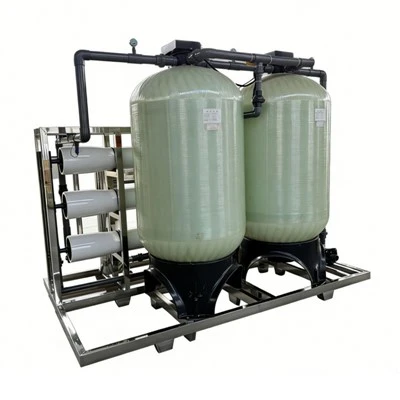
Two resin vessels operate alternately. One vessel supplies softened water while the other regenerates or remains on standby. This arrangement is suitable for facilities requiring continuous soft water availability.
Multi-Tank Parallel Water Softeners
Multiple resin vessels operate in parallel to distribute treatment flow across several units. These systems are used in industrial plants with high or variable water demand.
Skid-Mounted Water Softening Systems
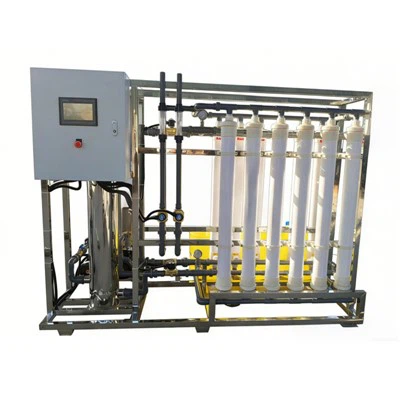
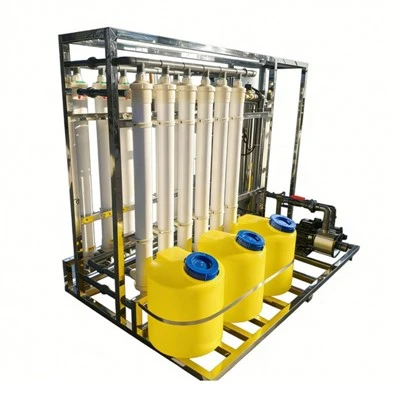
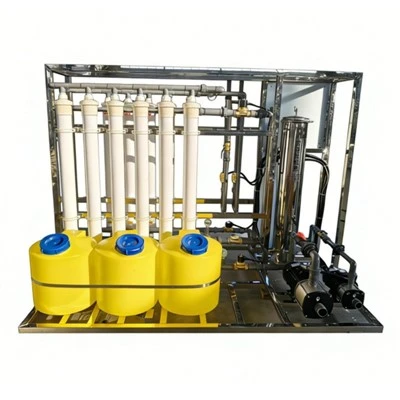
Factory-assembled systems integrate resin vessels, control valves, brine tanks, pipe manifolds, and electrical controls on a common frame. Pretreatment filters and additional monitoring instruments can be included in the system design.
Water softening is based on ion exchange between sodium-form resin and dissolved hardness ions.
Service Cycle
Raw water passes through the resin bed. Calcium and magnesium ions attach to the resin, releasing sodium ions into the treated water.
2R–Na + Ca²⁺ → R₂Ca + 2Na⁺
Backwash
Water flows upward through the resin bed to loosen the resin and remove accumulated suspended particles. Backwash flow is selected according to resin specifications and water temperature.
Brine Injection and Slow Rinse
A sodium chloride solution passes through the resin vessel. Sodium ions replace the accumulated calcium and magnesium ions, restoring the resin to its sodium form.
R₂Ca + 2Na⁺ → 2R–Na + Ca²⁺
Fast Rinse
Water flushes residual brine and displaced hardness ions from the resin bed before the vessel returns to service.
Brine Tank Refill
The control valve replenishes the brine tank with water for preparation of the next regeneration cycle.
Technical Specifications
|
Parameter |
Available Specification |
||||
|
Equipment type |
Single-tank, duplex alternating, multi-tank parallel |
||||
|
Model series |
YAR-S0.5T, YAR-S2.0T, YAR-S5.0T, YAR-D10T, YAR-D20T |
||||
|
Resin type |
Sodium-form strong acid cation exchange resin |
||||
|
Resin volume |
25 L, 75 L, 200 L, 2 × 300 L, 2 × 600 L |
||||
|
Vessel material |
FRP composite, SS304, SS316L |
||||
|
Regeneration agent |
Sodium chloride (NaCl) |
||||
|
Regeneration method |
Automatic backwash, brine injection, slow rinse, fast rinse |
||||
|
Control method |
Time-based or flow-meter-based regeneration |
||||
|
Connection type |
Threaded or flanged |
||||
|
Power supply |
AC 110 V or 220 V, 50/60 Hz control options |
||||
|
Installation |
Floor-mounted or skid-mounted |
||||
|
Control interface |
Local automatic control; RS485/Modbus options |
||||
|
Design considerations |
Raw water hardness, service flow, working exchange capacity, operating pressure |
||||
|
Model |
Resin Volume |
Proposed Flow Range |
|||
|
YAR-S0.5T |
25 L |
0.5–1.5 m³/h |
|||
|
YAR-S2.0T |
75 L |
2.0–3.5 m³/h |
|||
|
YAR-S5.0T |
200 L |
5.0–8.0 m³/h |
|||
|
YAR-D10T |
2 × 300 L |
10–15 m³/h |
|||
|
YAR-D20T |
2 × 600 L |
20–30 m³/h |
|||

Boiler Feed Water Pretreatment: Removes calcium and magnesium hardness before subsequent boiler feed water treatment stages. Additional treatment may be required to control dissolved oxygen, alkalinity, and other water quality parameters.
Cooling Tower Makeup Water: Controls hardness in makeup water where calcium and magnesium scale is a concern. System selection should also consider chloride, silica, alkalinity, and corrosion control.
Industrial Process Water: Supplies softened water for textile processing, paper production, chemical manufacturing, and equipment cleaning applications where reduced hardness is required.
Commercial Hot Water Systems: Provides softened water for hotels, hospitals, laundries, commercial water heaters, and central hot water installations.
Key Selection Factors
Raw Water Quality: Obtain a water analysis covering total hardness, iron, manganese, TDS, pH, and alkalinity. High iron or suspended solids may require pretreatment before ion exchange.
Resin Exchange Capacity: Calculate the required resin volume using raw water hardness, resin working exchange capacity, and the required treated water volume between regeneration cycles.
Service Flow Rate: Calculate normal and peak water demand. Check vessel diameter, resin bed depth, and service velocity when selecting equipment capacity.
Regeneration Requirements: Evaluate salt consumption, regeneration water consumption, drainage capacity, and regeneration duration.
Operating Continuity: Select single-tank equipment for intermittent demand or duplex alternating systems where continuous softened water supply is required.
Installation and Controls: Check available floor space, inlet and outlet connections, electrical supply, drainage location, and required PLC or SCADA communication interfaces.
FAQ

Request a Quote
To select an industrial water softening system, provide the following information:
Required normal and peak flow rates (m³/h).
Raw water analysis, including total hardness, iron, manganese, TDS, and pH.
Required treated water hardness.
Daily operating hours and water consumption.
Continuous supply requirements and preferred vessel configuration.
Available electrical supply and installation space.
Preferred vessel material, connection type, and automation requirements.
These details help determine resin volume, vessel size, regeneration frequency, salt consumption, and the appropriate system configuration.
We're well-known as one of the leading water softening system manufacturers and suppliers in China, featured by quality products and good price. Please rest assured to buy bulk water softening system made in China here from our factory. Customized orders are welcome.