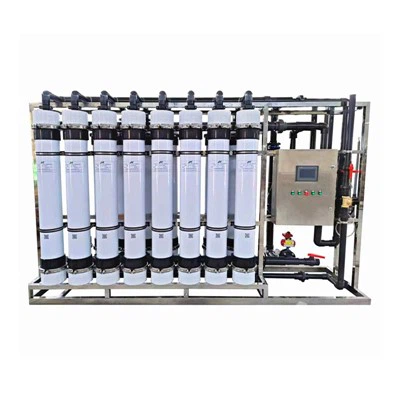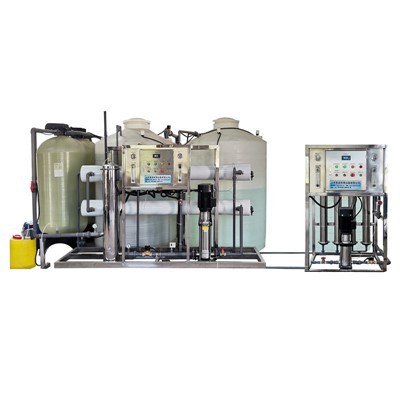


The Duplex Parallel Water Softener System uses two ion exchange resin vessels with automatic alternating control to provide a continuous supply of softened water for industrial and commercial applications. During normal operation, one tank supplies treated water while the second tank remains on standby or undergoes regeneration. When the operating tank reaches its programmed regeneration point, the control valve transfers the service flow to the standby tank.
Each vessel contains sodium-form strong acid cation exchange resin, which removes dissolved calcium and magnesium ions from incoming water. The system uses an automatic metered control valve to monitor water consumption and initiate regeneration according to accumulated flow.
This configuration is suitable for facilities requiring continuous softened water, including boiler feedwater pretreatment, HVAC systems, commercial laundries and industrial process water supplies. System sizing is based on raw water hardness, required service flow, daily water consumption and regeneration requirements.
Key Features
Alternating Dual-Tank Operation: One vessel remains in service while the other is on standby or undergoing regeneration.
Automatic Metered Regeneration: Flow-based control initiates regeneration according to accumulated treated water volume.
FRP Pressure Vessels: Fiberglass-reinforced plastic outer shells with polyethylene inner liners.
Automatic Multi-Port Valve: Controls service, backwash, brine draw, slow rinse, fast rinse and brine refill cycles.
Strong Acid Cation Resin: Sodium-cycle resin exchanges calcium and magnesium ions for sodium ions during water treatment.
Continuous Water Supply Design: The standby vessel takes over service flow during regeneration of the operating vessel, within the system's rated capacity.
Technical Specifications
|
Parameter |
Specification |
|
System Configuration |
Twin-Tank Alternating Operation |
|
Service Flow Rate |
2.0–15.0 m³/h |
|
Operating Pressure |
0.20–0.60 MPa |
|
Operating Temperature |
5–50°C |
|
Vessel Material |
FRP Outer Shell with PE Inner Liner |
|
Vessel Pressure Rating |
1.0 MPa |
|
Resin Type |
Sodium-Form Strong Acid Cation Exchange Resin |
|
Control Valve |
Automatic Meter-Initiated Multi-Port Valve |
|
Regeneration Stages |
Backwash, Brine Draw, Slow Rinse, Fast Rinse and Brine Refill |
|
Brine Tank Capacity |
100–1,000 L |
|
Power Supply |
110 V / 220 V, 50/60 Hz |
|
Pipe Connections |
1–3 inch |
|
Connection Types |
NPT, BSPT Threaded or ANSI/DIN Flanged |
Applications
Boiler Feedwater Pretreatment: Reduces calcium and magnesium hardness in makeup water before it enters boiler feedwater treatment equipment.
HVAC Cooling Systems: Treats makeup water supplied to cooling towers, chillers and associated heat exchange equipment.
Commercial Laundry: Supplies softened water for washing machines and laundry processing systems where hardness control is required.
Food and Beverage Processing: Provides softened water for equipment feedwater, steam generation and utility water treatment.
Commercial Car Wash Systems: Treats water used in vehicle washing and final rinse processes to reduce mineral deposits.
Working Principle
The system operates through sodium-cycle cation exchange. Hard water enters the active resin vessel, where calcium (Ca²⁺) and magnesium (Mg²⁺) ions are captured by the resin. Sodium (Na⁺) ions are released into the treated water as the exchange process takes place.
When the programmed water volume is reached or the regeneration demand is triggered, the control valve transfers service to the standby vessel. The exhausted resin vessel then undergoes regeneration through four stages:
Backwash: Water flows upward through the resin bed to loosen the media and remove accumulated suspended particles.
Brine Draw and Slow Rinse: Sodium chloride solution passes through the resin bed to replace accumulated calcium and magnesium ions.
Fast Rinse: Water flows through the vessel to remove residual brine from the resin bed.
Brine Refill: Water enters the brine tank to prepare the solution for the next regeneration cycle.
After regeneration, the vessel returns to standby status for the next service cycle.
Customization Options
Vessel Material: FRP vessels or stainless steel construction in SS304 or SS316L.
System Assembly: Skid-mounted configurations with pre-installed piping, valves and electrical control components.
Control Valves: Automatic multi-port valves with metered regeneration control.
Control Integration: Digital controllers with Modbus RTU or RS485 communication for compatible PLC and BMS systems.
Connection Options: Threaded or flanged inlet, outlet and drain connections.
FAQ
Q: How does the system maintain water supply during regeneration?
A: The standby vessel takes over the service flow while the other vessel undergoes regeneration. The available flow must remain within the standby vessel's rated capacity.
Q: What determines the regeneration frequency?
A: Regeneration frequency depends on raw water hardness, resin volume, exchange capacity and daily water consumption.
Q: How much salt does each regeneration cycle require?
A: Salt dosage is calculated from resin volume and the selected regeneration setting. The required quantity should be established from the resin manufacturer's technical data.
Q: What utilities are required for installation?
A: Installation requires a raw water inlet, treated water outlet, drainage connection, brine tank and electrical supply for the automatic control system.
Request a Quote
To select a Duplex Parallel Water Softener System, provide the following information:
- Required service flow rate (m³/h).
- Raw water hardness (mg/L as CaCO₃).
- Target treated water hardness.
- Daily water consumption and operating hours.
- Available inlet pressure and pipe connection size.
- Preferred vessel material and control system requirements.
These details help determine resin volume, vessel dimensions, regeneration settings and the appropriate system configuration.
Hot Tags: duplex parallel water softener system, China duplex parallel water softener system manufacturers, suppliers, factory