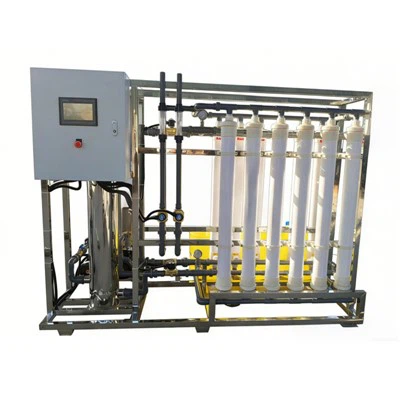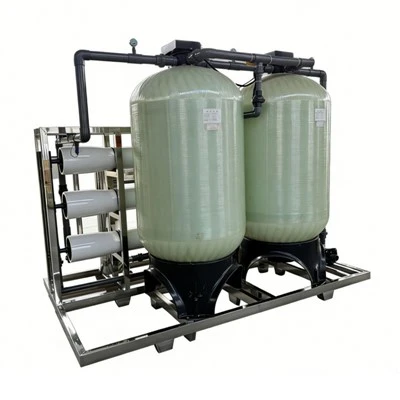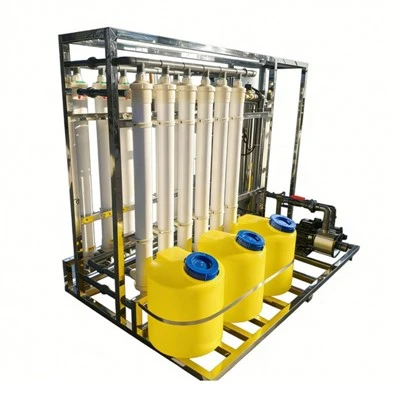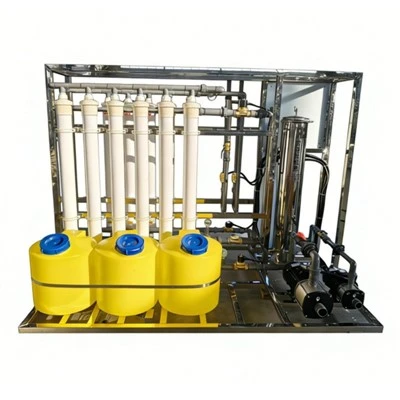

Pretreatment & Filtration Equipment
Industrial Pretreatment & Filtration Equipment removes suspended solids, sediment, rust particles, and other insoluble contaminants from raw water, process liquids, and industrial wastewater. These systems are commonly installed before reverse osmosis (RO) membranes, ultrafiltration (UF) units, heat exchangers, cooling water circuits, and downstream process equipment that requires controlled particulate levels.
This category includes automatic self-cleaning filters, multi-cartridge filter housings, multi-bag filter vessels, and granular media filtration systems. Each type uses a different filtration mechanism to handle specific particle sizes, flow requirements, and solid loading conditions.
-
![Iron And Manganese Removal Filter]() Iron And Manganese Removal FilterThe Iron and Manganese Removal Filter is an industrial pressure filtration system designed to reduce dissolved iron and manganese in groundwater, well water, and industrial process water. It uses a catalytic filter media bed to promote...view more
-
![Automatic Backwash Filter]() Automatic Backwash FilterAn Automatic Backwash Filter is an industrial self-cleaning filtration system designed to remove suspended solids from continuously flowing liquids. It is installed in pipelines to protect pumps, heat exchangers, spray nozzles,...view more
-
![Precision Cartridge Filter System]() Precision Cartridge Filter SystemThe Precision Cartridge Filter System is engineered for continuous particulate removal in industrial fluid loops and parts washing lines. By removing suspended chips, metal fines, and contaminants down to sub-micron levels, this unit...view more
-
![Activated Carbon Water Filter]() Activated Carbon Water FilterThe Activated Carbon Water Filter is designed to reduce free chlorine, taste, odor and selected organic compounds in industrial and commercial water treatment systems. It uses granular activated carbon (GAC) or compressed carbon block...view more
-
![Quartz Sand Water Filter]() Quartz Sand Water FilterA Quartz Sand Water Filter is a pressure filtration system designed to remove suspended solids, sediment, and particulate matter from industrial process water, groundwater, and surface water. It uses graded quartz sand as the primary...view more
-
![Industrial Multimedia Water Filter]() Industrial Multimedia Water FilterAn Industrial Multimedia Water Filter is a pressure filtration unit used to remove suspended solids, sediment, sand and other particulate impurities from industrial raw water. It uses multiple layers of granular filtration media with...view more


Key Features
Continuous Filtration
Automatic self-cleaning filters remove accumulated particles through suction scanning, brush cleaning, or scraper mechanisms while maintaining the main process flow.
01
Multiple Filtration Mechanisms
Screen elements, cartridge media, filter bags, and granular filter beds accommodate different particle characteristics and filtration requirements.
02
Pressure-Based Monitoring
Differential pressure gauges or transmitters monitor pressure loss across filter elements and provide information for cleaning or replacement.
03
Industrial Material Options
Filter vessels are available in stainless steel, carbon steel, and corrosion-resistant alloy constructions for different liquid compositions and operating environments.
04
Flexible System Integration
Inlet and outlet connections, drainage arrangements, control panels, and vessel configurations can be specified for integration into industrial water treatment skids and piping systems.
05
Product Types
|
Product Type |
Filtration Mechanism |
Typical Filtration Range |
Main Applications |
|
Automatic Self-Cleaning Filter |
Wedge-wire screen with suction scanner, brush, or scraper cleaning |
50–3000 μm |
Raw water intake, cooling water, industrial circulation |
|
Multi-Cartridge Filter Housing |
Replaceable pleated or depth cartridges |
1–100 μm |
RO pretreatment, process water, fine particle removal |
|
Multi-Bag Filter Vessel |
Replaceable needle-felt or monofilament filter bags |
1–200 μm |
Industrial liquids, wastewater polishing, chemical processing |
|
Media Filtration System |
Quartz sand, anthracite, or activated carbon filter beds |
Particle removal determined by media and bed design |
Turbidity reduction, sediment removal, organic matter adsorption |
Automatic self-cleaning filters are suitable for continuous operation where accumulated screen particles need periodic removal. Cartridge housings provide finer particulate filtration through replaceable elements. Bag filter vessels accommodate different liquid volumes and solid loading conditions, while media filtration systems use granular filter beds for bulk water treatment.
Automatic Self-Cleaning Filters
Incoming water passes through a cylindrical screen, where suspended particles are retained on the filtration surface. As particles accumulate, the differential pressure between the inlet and outlet increases.
When the configured differential pressure or cleaning timer reaches its setpoint, the control system activates the cleaning sequence. Depending on the filter design, a suction scanner, rotating brush, or mechanical scraper removes accumulated solids. A drain valve then discharges the collected contaminants. The main filtration process continues during automatic cleaning in designs intended for on-line operation.
Cartridge and Bag Filter Housings
Liquid enters the pressure vessel and flows through replaceable filter elements. Particles are retained on the surface or within the depth structure of the cartridge or filter bag. The filtered liquid passes through the element outlet and exits through the vessel outlet connection.
Operators monitor differential pressure to determine when filter elements require replacement. Used cartridges or bags are removed during maintenance, and replacement elements are installed according to the vessel design.
Media Filtration Systems
Raw water flows through a granular media bed containing quartz sand, anthracite, or other selected filter materials. Suspended particles are retained within the bed through physical straining and related filtration mechanisms. Backwashing reverses or redistributes the water flow to remove accumulated solids from the media.

Technical Specifications
|
Parameter |
Technical Specifications / Options |
|
Equipment Types |
Automatic self-cleaning, cartridge, bag, and media filters |
|
Design Pressure Options |
0.6, 1.0, 1.6, 2.5 MPa |
|
Operating Temperature |
-10°C to +95°C |
|
System Flow Capacity |
5–2000 m³/h |
|
Screen Filtration Range |
50–3000 μm |
|
Cartridge Filtration Range |
1–100 μm |
|
Bag Filtration Range |
1–200 μm |
|
Filter Media |
Quartz sand, anthracite, activated carbon |
|
Vessel Materials |
SS304, SS316L, Duplex 2205, carbon steel |
|
Seal Materials |
EPDM, FKM, PTFE, silicone |
|
Connections |
ANSI B16.5, DIN, JIS, GB/T flange options |
|
Control System |
PLC control, differential pressure monitoring, automatic valve control |
|
Electrical Supply |
220 V / 380 V / 440 V, 50/60 Hz |
|
Cleaning Methods |
Suction scanning, brush cleaning, scraper cleaning, media backwashing |
|
Operation |
Automatic or manual control |

RO and UF Pretreatment: Removes suspended particles before membrane filtration. Cartridge filters can serve as a final particulate barrier upstream of RO membranes.
Cooling Tower Water Treatment: Captures sediment, corrosion particles, and suspended debris in cooling water circulation and side-stream filtration systems.
Industrial Process Water: Filters river water, groundwater, and recycled process water used in paper manufacturing, textile production, steel processing, and general industrial operations.
Wastewater Treatment: Provides preliminary or tertiary particulate removal before subsequent treatment, discharge, or internal water reuse.
Chemical and Petrochemical Processing: Filters insoluble particles, catalyst residues, and process debris from compatible liquid streams. Filter vessel materials and sealing components must be selected according to chemical compatibility.
Key Selection Factors
Inlet Water Quality: Evaluate turbidity, suspended solids concentration (TSS), particle size distribution, and the physical characteristics of contaminants.
Required Flow Rate: Calculate peak operating flow rather than relying only on average daily consumption. Flow capacity affects vessel dimensions, filtration area, and the number of filter elements.
Target Filtration Rating: Select the required micron rating according to downstream equipment protection and process water quality requirements.
Operating Pressure and Temperature: Check normal operating pressure, maximum design pressure, temperature limits, and pressure fluctuations.
Material Compatibility: Consider chloride concentration, pH, chemical composition, and process temperature when selecting SS304, SS316L, Duplex stainless steel, or carbon steel with protective lining.
Maintenance Requirements: Compare automatic cleaning frequency, backwash water consumption, cartridge replacement intervals, bag replacement procedures, and available maintenance space.
FAQ

Request a Quote
To receive an equipment recommendation and technical quotation, provide the following information:
Required flow rate (m³/h or GPM)
Inlet water turbidity and suspended solids concentration (TSS)
Target filtration rating (μm)
Liquid composition and chemical characteristics
Normal operating pressure and temperature
Required vessel and filter element materials
Automatic or manual operation preference
Installation location and available space
Applicable project standards and documentation requirements
For complete filtration system proposals, buyers can also provide downstream equipment specifications, required outlet water quality, and existing process flow diagrams. This information helps determine the filtration stages, vessel configuration, and operating requirements.
We're well-known as one of the leading pretreatment & filtration equipment manufacturers and suppliers in China, featured by quality products and good price. Please rest assured to buy bulk pretreatment & filtration equipment made in China here from our factory. Customized orders are welcome.