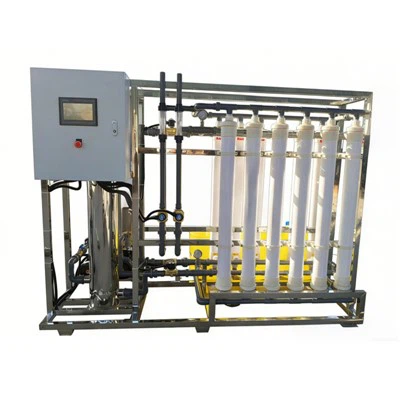


The Iron and Manganese Removal Filter is an industrial pressure filtration system designed to reduce dissolved iron and manganese in groundwater, well water, and industrial process water. It uses a catalytic filter media bed to promote oxidation and retain insoluble metal particles during filtration.
Dissolved ferrous iron (Fe²⁺) is oxidized into ferric iron (Fe³⁺), which subsequently forms insoluble iron hydroxide particles. Manganese (Mn²⁺) is converted into insoluble manganese oxide compounds under suitable pH and oxidation conditions. The filter media retains these precipitates before treated water enters downstream equipment.
Available in single-tank and multi-tank configurations, the system supports automatic backwashing through timer-based or differential-pressure-based controls. FRP, epoxy-lined carbon steel, and stainless steel vessels are available for different installation and operating requirements.
Key Features
Catalytic Filter Media: Manganese dioxide-based media promotes iron and manganese oxidation and provides a filtration surface for retaining precipitated particles.
Automatic Backwashing: Multi-port valves or multi-valve assemblies control service, backwash, and rinse cycles through electronic timers or PLC systems.
Multiple Vessel Materials: FRP vessels with PE liners, epoxy-lined carbon steel, and SS304 vessels accommodate different pressure and installation requirements.
Uniform Water Distribution: Hub-lateral or slot-nozzle underdrain systems distribute service water and backwash flow across the media bed.
Differential Pressure Monitoring: Optional pressure gauges and differential pressure switches monitor filter loading and initiate backwashing when the preset pressure differential is reached.
Technical Specifications
|
Parameter |
Specification |
|
Equipment Type |
Pressurized catalytic media filter |
|
Treatment Targets |
Dissolved iron, manganese; optional hydrogen sulfide reduction |
|
Single-Tank Flow Rate |
5–80 m³/h (22–350 GPM) |
|
Operating Pressure |
0.2–0.6 MPa (29–87 psi) |
|
Inlet Water Temperature |
5–45°C |
|
Inlet Iron Concentration |
Up to 15 mg/L |
|
Inlet Manganese Concentration |
Up to 3 mg/L |
|
Treated Water Iron |
Below 0.3 mg/L |
|
Treated Water Manganese |
Below 0.05 mg/L |
|
Filter Media |
Manganese dioxide-based catalytic media |
|
Vessel Materials |
FRP with PE liner / Epoxy-lined carbon steel / SS304 |
|
Control Mode |
Manual / Automatic timer / Differential pressure / PLC |
|
Backwash Mode |
Automatic or manual hydraulic backwash |
|
Power Supply |
220V, 50/60Hz or 110V, 60Hz |
|
System Configuration |
Single / Duplex / Triplex / Multi-tank |
|
Installation |
Individual vessel / Skid-mounted assembly |
Applications
Groundwater Pretreatment: Removes iron and manganese before reverse osmosis, ultrafiltration, and ion-exchange systems.
Municipal Water Treatment: Treats deep-well water before downstream disinfection and distribution.
Food and Beverage Processing: Reduces metallic contaminants in source water used for production and equipment washing.
Boiler Feed Water Pretreatment: Removes iron and manganese before softening, demineralization, or reverse osmosis.
Agricultural Irrigation: Treats iron-rich well water to reduce suspended deposits that can accumulate in drip irrigation emitters.
Working Principle
Service Filtration: Raw water enters through the upper distributor and flows downward through the catalytic media bed. Dissolved Fe²⁺ undergoes oxidation to Fe³⁺ and forms insoluble iron hydroxide particles. Mn²⁺ oxidation produces insoluble manganese oxide compounds under suitable treatment conditions. The media bed retains the resulting particles.
Backwashing: When the preset timer expires or the differential pressure reaches its trigger point, the control valve switches to backwash mode. Water flows upward through the media bed, expanding and agitating the media to release accumulated iron and manganese deposits. Suspended solids are discharged through the drain line.
Fast Rinse: Water flows downward through the media bed to resettle the filter material and flush remaining suspended particles before normal filtration resumes.
Customization Options
Media Selection: Manganese dioxide-based catalytic media selected according to raw water chemistry and treatment requirements.
Oxidation Systems: Optional aeration, chlorine, potassium permanganate, or ozone dosing equipment for applications requiring additional oxidation.
Vessel Configuration: FRP, epoxy-lined carbon steel, and stainless steel construction.
Control Systems: Manual valves, automatic multi-port valves, differential pressure controls, and PLC-based control panels.
Multi-Tank Systems: Duplex, triplex, and parallel configurations for continuous water treatment.
Skid-Mounted Systems: Integrated piping, pressure gauges, sampling valves, isolation valves, and electrical control panels.
Key Selection Factors
Equipment selection requires raw water analysis and the required treated-water quality. Important parameters include inlet iron and manganese concentrations, pH, dissolved oxygen, hydrogen sulfide concentration, suspended solids, and required flow rate.
Tank diameter, filtration velocity, media depth, and backwash flow rate should be established during engineering design. Applications with insufficient dissolved oxygen or difficult manganese removal conditions may require upstream oxidation or pH adjustment.
FAQ
Q: What pH is required for iron and manganese removal?
A: Iron generally oxidizes and precipitates under less demanding pH conditions than manganese. Manganese removal often requires higher pH or additional oxidation. The appropriate operating range depends on media type and raw water chemistry.
Q: Does the filter require chemical dosing?
A: Not every application requires continuous chemical dosing. Aeration or chemical oxidation may be necessary when dissolved oxygen or natural oxidation conditions are insufficient.
Q: How often does the system require backwashing?
A: Backwash frequency depends on incoming suspended solids, iron and manganese loading, filtration velocity, and pressure differential. Timer-based and differential-pressure-based controls are available.
Q: How should backwash wastewater be handled?
A: Backwash wastewater contains accumulated iron and manganese solids. It should be discharged to an approved treatment or disposal system in accordance with local regulations.
Request a Quote
Submit your required flow rate, raw water analysis, and treated-water specifications to receive a suitable filtration system configuration and quotation
Hot Tags: iron and manganese removal filter, China iron and manganese removal filter manufacturers, suppliers, factory