
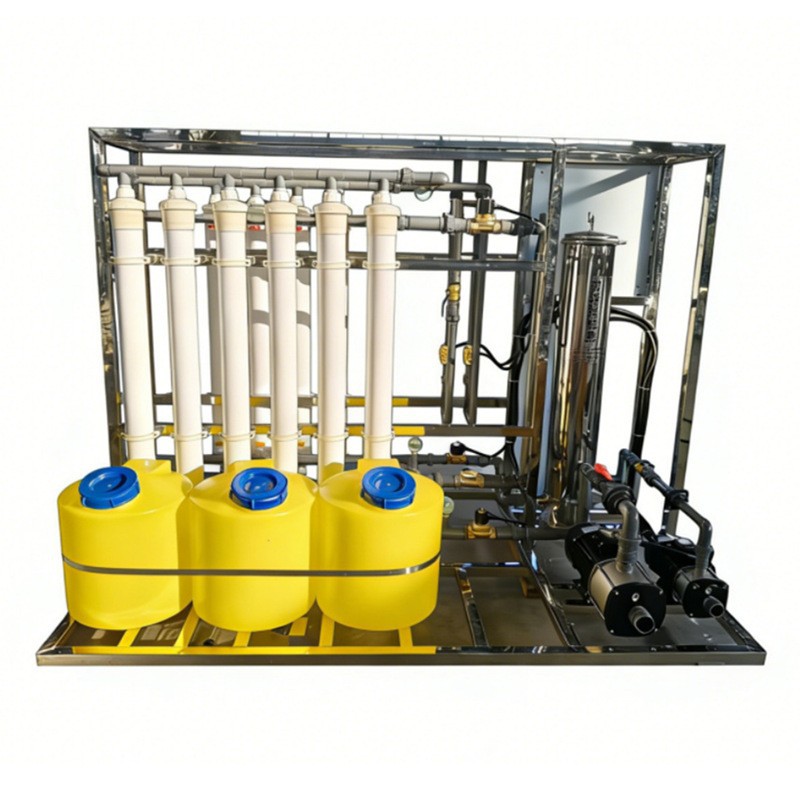
An Antiscalant Dosing System is a skid-mounted chemical injection unit used in reverse osmosis (RO) water treatment plants. It delivers controlled quantities of antiscalant into RO feedwater to inhibit mineral scale formation on membrane surfaces.
The system typically consists of a chemical storage tank, metering pump, suction and discharge piping, injection assembly, calibration cylinder, and electrical control panel. The metering pump transfers antiscalant solution from the storage tank to the feedwater pipeline, maintaining the required chemical dosage according to water flow and treatment requirements.
Common target scale-forming compounds include calcium carbonate, calcium sulfate, and barium sulfate. The system is used in seawater desalination, brackish water treatment, and industrial wastewater reclamation facilities.
Key Features
Skid-Mounted Structure: Integrated equipment assembly on a coated carbon steel or stainless steel base frame, with internal piping and accessories arranged for plant installation.
Metering Pump Options: Solenoid-driven diaphragm, motor-driven diaphragm, and plunger pumps for different dosing capacities and discharge pressures.
Chemical-Resistant Components: Available wetted materials include PVDF, PVC, PTFE, and 316 stainless steel. Material selection considers antiscalant composition and operating conditions.
Dosing Control: Manual adjustment or automatic flow-paced control through 4–20 mA and pulse signals from external flow meters.
Integrated Protection: Optional pressure relief valves, back-pressure valves, pulsation dampeners, calibration cylinders, and tank-level switches.
Electrical Control: Control cabinet with IP55 enclosure protection for local operation and optional PLC or SCADA communication.
Technical Specifications
|
Parameter |
Specification |
|
Equipment Type |
Skid-mounted chemical dosing system |
|
Dosing Capacity |
2–1,000 L/h |
|
Maximum Discharge Pressure |
0.3–2.5 MPa |
|
Storage Tank Capacity |
100–2,000 L |
|
Tank Material |
UV-stabilized HDPE |
|
Pump Type |
Solenoid diaphragm / Motor-driven diaphragm / Plunger |
|
Pump Head Materials |
PVDF / PVC / 316 Stainless Steel |
|
Diaphragm Material |
PTFE |
|
Piping Materials |
PVC / PVDF / 316 Stainless Steel |
|
Control Modes |
Manual / Automatic flow-paced dosing |
|
Input Signals |
4–20 mA / Pulse frequency |
|
Power Supply |
220 V, 1 Phase, 60 Hz / 380 V, 3 Phase, 50 Hz |
|
Control Cabinet |
IP55 |
|
Pump Configuration |
Single pump / Duty-standby dual pumps |
|
Installation |
Skid-mounted |
|
Optional Accessories |
Calibration cylinder, pulsation dampener, pressure relief valve, back-pressure valve, level switch |
Applications
Seawater and Brackish Water RO: Injects antiscalant into feedwater upstream of RO membrane units to control calcium carbonate, calcium sulfate, and other scale-forming deposits.
Power Plant RO Pretreatment: Supplies antiscalant to reverse osmosis systems used for producing treated water in power generation facilities.
Industrial Wastewater Reclamation: Supports RO membrane operation in wastewater recycling and high-recovery water treatment processes.
Ultrapure Water Pretreatment: Provides chemical dosing in RO pretreatment stages of water systems serving electronics and semiconductor manufacturing facilities.
Working Principle
The system uses a positive displacement metering pump to transfer antiscalant solution from the storage tank into the RO feedwater pipeline. Chemical passes through the suction line and pump check valves before entering the discharge manifold and injection assembly.
In automatic flow-paced operation, an external flow meter sends a 4–20 mA or pulse signal to the control panel. The controller adjusts pump output according to the measured feedwater flow rate and programmed dosing ratio.
The antiscalant disperses into the feedwater and interferes with mineral crystal formation and growth. The required dosage depends on feedwater chemistry, recovery rate, temperature, membrane arrangement, and the selected antiscalant formulation.
Key Selection Factors
Feedwater Flow Rate: Pump capacity should cover the normal and maximum RO feedwater flow rates.
Antiscalant Dosage: Required dosing capacity is calculated from water flow, target chemical concentration, and prepared solution concentration.
Discharge Pressure: Pump pressure rating must exceed the pressure at the injection point, including pressure losses in the discharge assembly.
Chemical Compatibility: Pump heads, diaphragms, seals, valves, and piping materials must match the chemical formulation.
Storage Capacity: Tank volume is determined by daily chemical consumption and the required replenishment interval.
Control Requirements: Manual control suits basic installations, while flow-paced control supports automatic adjustment when feedwater flow changes.
Customization Options
Available configurations include duty-standby dual metering pumps, automatic pump changeover, low-level tank alarms, dry-run protection, and outdoor FRP protective enclosures. PLC-based control panels can also be configured for plant monitoring and remote operation.
Engineering documentation can include general arrangement drawings, P&ID diagrams, electrical drawings, and equipment data sheets.
FAQ
Q: How is the dosing pump capacity calculated?
A: The calculation uses feedwater flow rate, target antiscalant dosage, prepared solution concentration, and solution density.
Q: Can the system connect to an existing PLC or DCS?
A: Yes. Flow-paced control can use 4–20 mA or pulse inputs, while remote run status and fault signals can be provided through configured electrical interfaces.
Q: What maintenance is required?
A: Routine maintenance includes checking pump diaphragms, suction and discharge check valves, seals, strainers, tank connections, and injection points.
Q: Can the system operate continuously?
A: Yes. The pump and tank configuration can be selected for continuous dosing duty. Dual-pump arrangements are available for duty-standby operation.
Request a Quote
To receive a technical proposal and equipment quotation, provide the following information:
- Normal and maximum RO feedwater flow rate (m³/h)
- Feedwater operating pressure (MPa or bar)
- Antiscalant type and target dosage (mg/L or ppm)
- Prepared chemical solution concentration
- Required storage tank capacity (L)
- Electrical supply (V/Hz/Phase)
- Control requirements (manual or automatic flow-paced dosing)
Preferred pump configuration (single or duty-standby)
Hot Tags: antiscalant dosing system, China antiscalant dosing system manufacturers, suppliers, factory